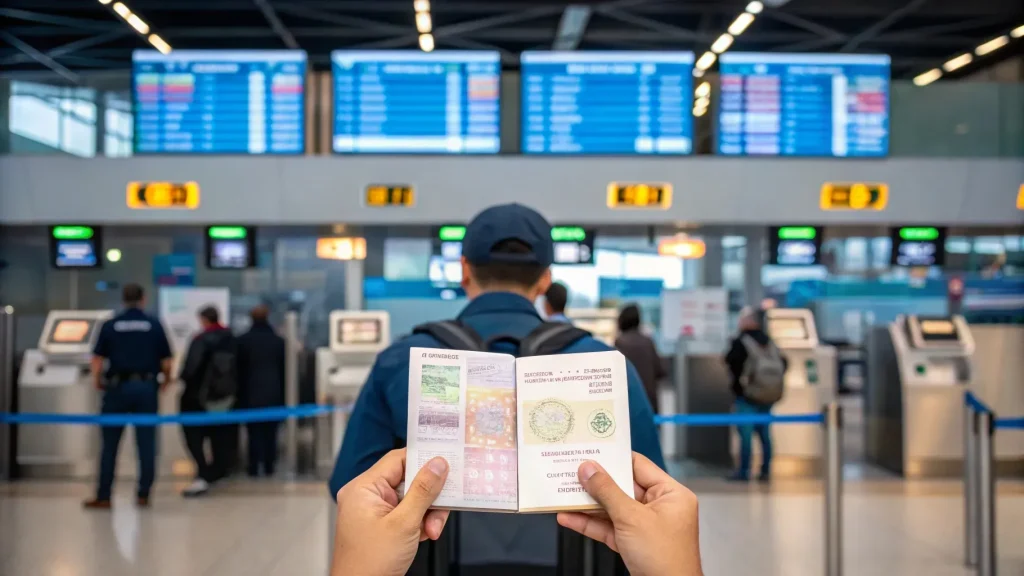
- Apply online via the official Indonesian immigration portal, Imigrasi.go.id.
- Initial validity is 30 days, extendable once for a further 30 days at an immigration office.
- An onward or return ticket proving departure within the initial 30-day period is mandatory.
As the cabin door opens at Ngurah Rai International Airport (DPS), the Balinese air, thick with tropical humidity and the faint perfume of frangipani, envelops you. This is the threshold to your new chapter, a transition from the UK’s temperate climes to the island’s vibrant rhythm. Navigating the entry requirements efficiently is paramount, and for those moving to Bali from UK shores, the electronic Visa On Arrival (e-VOA) stands as the definitive pathway for initial entry.
How do I get an e-VOA for Bali from the UK?
Securing your Bali e-VOA from the UK involves a structured online application through the Indonesian Directorate General of Immigration’s official portal. This digital pathway, designed for efficiency, requires meticulous attention to detail to ensure a smooth transition upon arrival at Ngurah Rai (DPS) or any other international entry point in Indonesia. The process begins with accessing the official Imigrasi.go.id website, specifically the e-VOA section. You will create an account using a valid email address, which will serve as your primary communication channel for application updates. Essential documents for the application include a digital copy of your passport, valid for at least six months from your intended arrival date in Indonesia. The passport must contain at least two blank pages for entry and exit stamps. Additionally, a recent passport-sized digital photograph meeting standard immigration specifications (typically 2×2 inches with a white background, captured within the last six months) is required. You must also provide comprehensive details of your intended accommodation in Indonesia, which can be a hotel booking confirmation in areas like Canggu, Ubud, or Sanur, or a residential address if you have already secured a long-term rental. Crucially, proof of an onward or return ticket is mandatory, demonstrating your departure from Indonesia within the initial 30-day e-VOA validity period. This could be a flight booking from DPS to Singapore (SIN) or Kuala Lumpur (KUL), for example. The application interface is intuitive, guiding you through personal data entry, travel plan declaration, and document uploads. Once all information is verified and documents are attached, you proceed to the payment gateway. The official processing time for an e-VOA is typically 2-3 business days, though applying at least 72 hours before your departure is a prudent measure. It is advisable not to apply more than 90 days prior to your travel date, as the e-VOA’s validity period commences from its issuance date, not your arrival date. Upon approval, your e-VOA will be sent to your registered email address as a PDF document. Print this document and keep a digital copy readily accessible on your mobile device for presentation to immigration officers upon arrival. This preparation streamlines your passage through Bali customs, circumventing potential delays.
Bali e-VOA vs. Traditional Visa On Arrival: Understanding Your Options
When preparing for entry to Indonesia, UK citizens encounter two primary options for short-term stays: the electronic Visa On Arrival (e-VOA) and the traditional Visa On Arrival (VOA) purchased directly at the airport. While both grant a 30-day stay, extendable once, their application processes and practical implications differ significantly. The e-VOA, as detailed, is applied for and paid online before your departure from the UK. This pre-arrival processing means that upon landing at Ngurah Rai International Airport (DPS), you bypass the potentially lengthy VOA payment queues. Instead, you proceed directly to immigration counters designated for e-VOA holders, often experiencing a more expedited clearance. This advantage is particularly noticeable during peak travel seasons, such as the dry season from April to October, when tourist arrivals can reach over 50,000 per day. The cost for both the e-VOA and the traditional VOA is identical: IDR 500,000 (approximately USD 32 or £25, subject to daily exchange rates). However, the e-VOA offers the convenience of paying in advance using a credit card, eliminating the need to handle cash in a foreign currency immediately upon arrival. The traditional VOA, conversely, requires payment at a dedicated counter within the airport’s arrival hall. This often means joining a queue, making the payment, and then proceeding to immigration. While straightforward, this two-step process can add 20-60 minutes to your arrival experience, depending on passenger volume. For those moving to Bali from UK and carrying significant luggage, perhaps even coordinating sea freight for personal effects or anticipating air freight shipments, the efficiency gained by using an e-VOA is invaluable. It reduces pre-entry stress, allowing for a smoother transition into Bali’s environment. The e-VOA is issued directly to your email, providing a clear document for presentation, whereas the traditional VOA involves a sticker placed in your passport at the airport. Both options provide the same legal entry status and extension possibilities, but the e-VOA’s digital pre-approval offers a distinct advantage in terms of time and convenience.
Do I need an onward ticket for Bali e-VOA?
Yes, an onward or return ticket is an absolute and mandatory requirement for obtaining a Bali e-VOA. Indonesian immigration regulations stipulate that all foreign visitors entering on a short-term visa, including the e-VOA, must demonstrate clear intent to depart the country within their permitted stay. This means your flight itinerary must show a confirmed departure from Indonesia within the initial 30-day validity period of your e-VOA. For example, if you arrive at Ngurah Rai (DPS) on June 1st, your onward ticket must confirm your departure on or before June 30th. This requirement is non-negotiable and immigration officers at both your departure airport in the UK and upon arrival in Indonesia may request to see this proof. Failure to present a valid onward ticket can result in denial of boarding by your airline in the UK, or refusal of entry by Indonesian immigration upon arrival. Airlines are liable for repatriating passengers denied entry, making them strict about verifying this document before departure. While the e-VOA application platform itself will prompt you to upload details of your onward journey, it is crucial to carry a printed copy of your flight booking confirmation, as well as digital copies, when travelling. Even if your long-term plan involves applying for a KITAS or another extended stay visa after your initial e-VOA period, the initial entry still necessitates proof of exit within 30 days. Many travellers moving to Bali from UK use flexible or refundable tickets for their onward journey, or book inexpensive flights to nearby hubs like Kuala Lumpur (KUL) or Singapore (SIN) to satisfy this condition. The cost of a budget flight to these destinations can range from USD 50-150 (IDR 750,000-2,250,000), providing a cost-effective solution to fulfil the onward ticket requirement e-VOA Bali. Ensure the onward ticket is for a commercial flight, as proof of departure by sea or land is typically more complex to verify and less commonly accepted for e-VOA purposes.
How much does Bali e-VOA cost for UK travellers?
The official cost for a Bali e-VOA for UK travellers is standardized at IDR 500,000. This fee is set by the Indonesian government and applies uniformly to all eligible nationalities. When applying online through the official Imigrasi.go.id portal, this payment is processed securely via credit or debit card. While the official price is in Indonesian Rupiah (IDR), your UK bank will convert this amount from GBP at the prevailing exchange rate on the day of the transaction. Typically, IDR 500,000 translates to approximately USD 32-35 or roughly £25-28, depending on the current interbank exchange rates. It is important to note that your bank may also levy a foreign transaction fee, which can add a small percentage (e.g., 1-3%) to the total cost. Therefore, while the base fee for your bali e voa cost in gbp is around £25-28, the final charge on your statement might be slightly higher due to these banking fees. There are no additional processing fees charged by the official e-VOA portal itself beyond the stated IDR 500,000. Beware of unofficial websites or third-party agencies that may charge significantly inflated prices for the same service; always use the government’s direct portal for application and payment to avoid scams and unnecessary expenses. For comparison, a traditional Visa On Arrival purchased at Ngurah Rai (DPS) also costs IDR 500,000, payable in IDR cash or by credit card at the airport counter. However, the convenience of pre-payment with the e-VOA often outweighs any minor currency conversion discrepancies. When budgeting for your move to Bali from UK, factor in this visa cost, alongside other initial expenses like accommodation deposits, transport from DPS to your chosen area like Seminyak or Ubud (a taxi to Seminyak is around IDR 200,000, to Ubud around IDR 350,000), and perhaps the initial rabies titre test for pets if you are bringing your furry companions.
Can I extend my e-VOA in Bali as a UK citizen?
Yes, as a UK citizen, you are eligible to extend your e-VOA once for an additional 30-day period while in Bali, effectively allowing a total stay of 60 days. This extension process must be initiated at an Indonesian immigration office (Kantor Imigrasi) before your initial 30-day e-VOA expires. It is crucial to begin the extension application process approximately 7-14 days before your initial visa expiry to allow ample time for processing. The most accessible immigration office for those residing in South Bali is typically the Kantor Imigrasi Kelas I TPI Denpasar, located in Renon. The process involves several steps: submitting an application, attending an interview, and undergoing fingerprinting and photo capture. You will need to bring your original passport, the printed e-VOA confirmation, and a copy of your onward ticket (even if it’s past the original 30 days, the initial proof is useful). You will also fill out an application form provided by the immigration office. While a sponsor letter was sometimes required for traditional VOA extensions, for e-VOA extensions, if you applied directly without a sponsor, you might not need one, but it’s always wise to confirm with the specific immigration office. The cost for the e-VOA extension is also IDR 500,000 (approximately USD 32 or £25), payable directly at the immigration office. This fee is paid at the final stage of the process, usually after your interview and biometrics. The extension process typically involves three visits to the immigration office: the first to submit documents, the second for biometrics (photo and fingerprints), and the third to collect your passport with the extended visa stamp. Ensure you dress appropriately for these visits – modest attire is expected. For those planning a longer stay beyond 60 days, perhaps awaiting a KITAS or other long-term visa, you will need to depart Indonesia before your extended e-VOA expires and re-enter on a new visa or e-VOA, or apply for a different visa type from outside the country. The “extend e voa bali as uk citizen” option provides a flexible initial period for those moving to Bali from UK, allowing time to settle in before committing to longer-term visa strategies.
Common Mistakes and Essential Tips for UK Applicants
Navigating the e-VOA application process from the UK, while generally straightforward, can be prone to common errors that lead to delays or even rejection. One of the most frequent mistakes is using unofficial websites or third-party agencies. Always ensure you are applying through the official Indonesian Directorate General of Immigration website, Imigrasi.go.id, to guarantee legitimacy and avoid inflated fees or scams. Double-check the URL meticulously. Another critical error involves passport details: ensure the information entered into the e-VOA application precisely matches your passport. Any discrepancy, even a minor spelling error or incorrect date of birth, can cause issues upon arrival at Ngurah Rai (DPS). Your passport must be valid for at least six months beyond your intended date of entry into Indonesia. If it expires sooner, renew it before applying for the e-VOA. Photograph specifications are also a common pitfall; ensure your digital photo adheres to the required dimensions (typically 2×2 inches), has a plain white background, and is recent (taken within the last six months) and clear, without glasses or headwear unless for religious reasons. Submitting an unclear or incorrectly sized photo will lead to application delays. Furthermore, neglecting the onward ticket requirement can halt your journey before it even begins. As previously discussed, secure your departure flight from Indonesia within 30 days of arrival before applying for the e-VOA and ensure you have proof ready. Upon successful e-VOA application, print multiple copies of your e-VOA confirmation email and keep digital copies on your phone and cloud storage. While immigration officers often have digital records, having a physical copy can expedite processing, especially in areas with slower internet connectivity or during system downtimes. For those moving to Bali from UK, consider the e-VOA as your initial stepping stone. Should you plan to bring pets, remember separate regulations apply, including rabies titre test results, which must be managed well in advance. Keep all your travel documents, including your e-VOA, passport, and onward ticket, easily accessible in your carry-on luggage. These precautions ensure a seamless entry into Bali, allowing you to focus on the excitement of your new home.
For UK citizens considering a move to Bali, understanding the e-VOA is foundational. Beyond the initial visa, the complexities of international relocation, from shipping your belongings via sea freight or air freight to relocating pets, require expert guidance. If you are navigating the intricacies of a long-term stay or need assistance with more complex visa categories like KITAS, our team is equipped to provide comprehensive support. Visit our homepage for further guides and resources on moving to Bali from UK, or contact the team for personalized assistance with your relocation journey.